


It’s been nearly a year since the City of Brownsville launched the creation of its first-ever strategic plan — an ambitious endeavor to transform the city’s urban core into the jewel of the Rio Grande Valley, which city leaders hope will attract visitors and tourists and spur economic growth.
In February, the strategic plan — known as the Downtown Renaissance Plan — entered a new phase, outlining key empirical steps and providing residents and stakeholders with a solid strategy moving forward.
The implementation and drafting phase of the master plan is the next-to-last step in the plan’s implementation process.
It is not unheard of for the downtown region of most large or mid-sized metropolitan cities to be considered the primary hub for commerce, business development, or city and county leadership.
However, there are quite a few cities where downtown celebrations and attractions are common, such as New Orleans and its famed Mardi Gras parade, and San Antonio, which hosts several annual celebrations, including Fiesta, Night in Old San Antonio, and more.
“Downtown Brownsville has always been a focus and a source of potential [improvements] for city leaders,” said Daniel Leal, Director of Planning and Redevelopment and Downtown at the City of Brownsville.
Leal said city leaders addressed potential improvements in the city’s 2009 Comprehensive Plan, but recent interest from public and private investors has spurred a renewed interest in downtown.
“City leaders realized they needed to create a much broader and deeper plan that establishes a renewed vision for the next 15 years,” Leal said. “That’s why it is called the Renaissance Plan. Building on existing success is what is driving this initiative and making sure that we sustain that progress for the long run.”
The study area for the Downtown Renaissance Master Plan includes the western segment of Palm Blvd to Mexico Blvd, then east to Interstate 69, which continues north toward Valley Baptist Medical Center.
The Back Story
In 2024, former Brownsville City Manager Helen Ramirez instructed the Planning Department to create the city’s first Master Plan, and then in 2025 entered into a consulting contract with Freese and Nichols.
 Leal said city leaders saw the need to create a plan that wasn’t just a chapter in a comprehensive plan, but a more strategic plan that incorporated sustainable, long-term goals and involved input from Brownsville residents with a viable interest in downtown.
Meanwhile, several subcontractors were added to the team, which included TXP, Inc., LOI Engineers, and Liveable Plans and Codes.
Leal added that Ramirez’s vision for downtown was crucial, specifically regarding key construction and renovation projects, including transforming the Majestic Theater into UTRGV’s new Performing Arts Center, as well as renovations to the El Jardin affordable housing project and the Samano Studios redevelopment.
Having the right people and organizations in place, he noted, is also key to success.
“I wanted to cast the broadest possible net for this plan,” said Leal. “I have always believed in the importance of public engagement, and we are really pushing the limits of public engagement with this plan. We have plenty of resources and the time research this to ensure that we do this very well.”
The Power of Public Engagement
 The official kick-off of the Brownsville Downtown Renaissance Master Plan had an almost pep-rally-like atmosphere that attracted all the major players, including city leaders and stakeholders, who turned out to generate excitement among the general public.
Residents have submitted many ideas, including more green spaces with native plants, better access to parking and public transportation, and walkable areas with convenient access to cafes, restaurants, shopping, and entertainment venues.
Leal said there will be more opportunities for Brownsville residents, business leaders, and stakeholders to share their ideas and desires before the plan is finalized and adopted this summer.
“We have set up different tiers of engagement,” Leal said. “Instead of asking everyone to go to your local community center for a 6 p.m. meeting, we set up different tiers to reach different audiences.”
For instance, the city commission hosted one of these meetings with steering committee members on March 3 to receive updates.
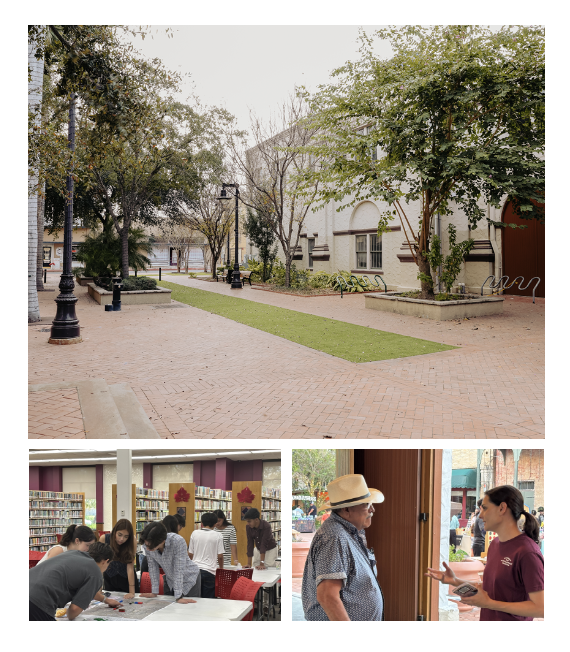 There are other meetings planned between the consultants and subconsultants with community stakeholders, business leaders, specialized institutions, youth organizations, non-profit organizations, faith groups, social services, health and wellness organizations, economic development, and elected officials.
Leal said there will also be several open house events open to the public, where information from other meetings will be shared as city leaders gather more public input. These will be advertised on social media platforms and through local media.
“We will also have numerous pop-up events, such as a table at the zoo, a farmer’s market, or some other local event,” said Leal. “Instead of having the people come to us, we want to go where the people are already.”
Leal said anyone interested in this plan is encouraged participate in the online survey on the City of Brownsville website, which also includes a detailed map of the downtown study area.
“This is a massive undertaking, but it’s also a worthwhile investment of time and resources,” he said. “We really want this to be the people of Brownsville’s plan, not the planning department’s plan.”

