


South Texas Health System (STHS) is expanding its medical services in the Rio Grande Valley by recruiting interventional radiology specialists for its locations in McAllen and Edinburg. These specialists rely on medical imaging systems for diagnostic and therapeutic procedures, thus providing a wide range of preventative and life-saving measures across the region.
Specialists in interventional radiology can perform image-guided operations by inserting devices into small incisions on the body. Radiology has depended on medical imaging since its earliest developmental stages, but its interventional uses originated in the 1960s. Among the earliest documented examples is a percutaneous transluminal angioplasty, a now-familiar procedure in which endovascular specialists use a balloon catheter to expand blood vessels and remedy blood flow disorders. Interventional radiology has since grown to encompass a number of complex procedures, many of which are increasing in availability throughout the Valley.
Dr. Mario Moya, M.D., a board-certified interventional radiologist, arrived at STHS in Jan. 2024. His passion for medical specialties has enabled him to combat a wide range of disorders in multiple organ systems.
“I came to introduce new service lines that are not currently in the pipeline of South Texas,” Moya said. “I’m trying to establish an interventional radiology practice to give the quality service that the community deserves.”
The interventional techniques at STHS offer a diversity of remedies for conditions such as high blood pressure, pulmonary embolisms, and metastatic cancer. One method of battling cancer involves injecting radioactive particles into malignant tumors, such as the radioactive isotope yttrium-90. Moya hopes to utilize additional interventional methods in the future, such as liquefying tumors with ultrasound waves.
“It’s through innovation like that that we’ve progressed to where we are,” Moya said. “I’m happy to be here because we’re providing a high-quality service.”
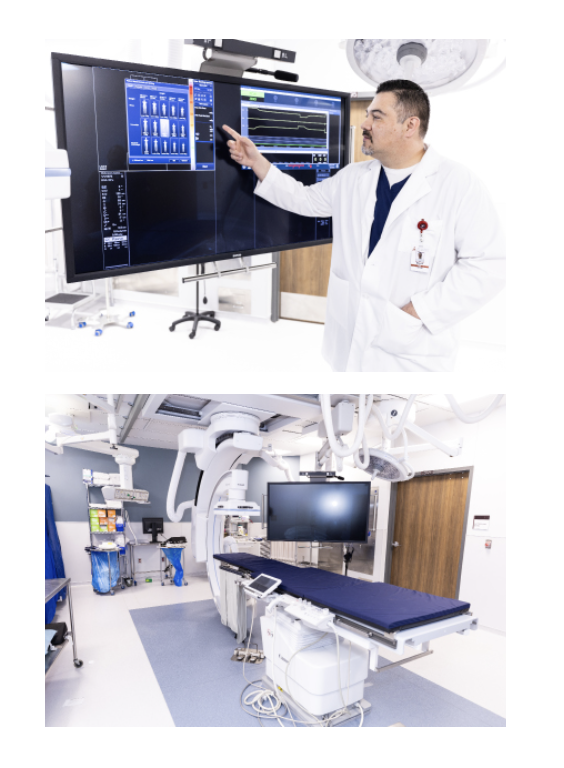 Documented cases in medical literature can affirm the success of image-guided procedures. Adding to their effectiveness is their simplicity for patients, who can enjoy the benefits of interventional radiology without hospitalization. Interventional procedures do not require general anesthesia, allowing specialists to provide same-day surgery for patients. Such operations rely on minimally invasive incisions, which enable fast recovery with little pain or scarring.
“I work with wires and catheters,” Moya said. “These can go in the groin or the radial artery at the wrist and work anywhere in the body.”
The lack of general anesthesia makes interventional procedures safer for high-risk patients, such as those with high blood pressure, diabetes, obesity, and other risk factors. The procedures depend on rigorous imaging technology and are therefore less likely than invasive surgeries to cause major blood loss or infection. Moya identifies hysterectomies as an example of an operation with a radiological alternative, explaining that particle injections can remedy uterine bleeding and enlarged fibroids without damaging fertility or the colon.
“Those types of complications don’t occur,” Moya said. “The treatments work, and patients don’t have to be hospitalized.”
STHS is optimistic that reduced hospitalization will allow superior services at lower costs. Their recruitment of specialists in McAllen and Edinburg reflects a larger mission to maximize local medical care quality and reduce dependence on major urban areas for effective treatments.
“Any system is only as good as the services it can provide,” Moya said. “As STHS has grown, they’ve realized the need to bring specialty services on board. That’s important for any type of health system to be able to survive and thrive.”
The organization’s enrichment of radiology services signifies the growing influence of the specialty as a whole. Efforts to institutionalize interventional treatments have spanned an entire generation of patients. Still, STHS hopes that the Rio Grande Valley can add to the specialty’s long record of success.
“Interventional radiology has a remarkable history,” Moya said. “Its pioneers had the vision to go against established norms to develop techniques which are integral to current clinical practices. I’m glad that we can bring this here to South Texas.”

